Best External Hard Drive for NAS Backup
Buy backup capacity on cost per terabyte, because a backup target has no performance requirement worth paying for. The WD Elements Desktop 18TB at $614.99 works out around $34 per terabyte and is the best value backup target here, and buying two to rotate is the correct pattern because the array is copy one and the third copy has to live somewhere else. Size the target against data held, not against array capacity.
This is not an accessory purchase. The array is copy one, and parity protects against a drive dying and nothing else, so the drives on this page are the part of the build that survives an accidental deletion, a ransomware run, a controller writing garbage across every member, a theft or a fire. A NAS without one of these is a fast working copy with no safety net, however many parity drives it has.
Three picks below, then the cost-per-terabyte table that should decide the purchase, then the restore arithmetic that decides whether the copy lives in your house or in the cloud.
Best backup drives by role

WD My Passport 5TB Portable Hard Drive
Bus powered, so the whole offsite copy fits in a coat pocket. That portability is the point of the third copy.
Best for: The offsite rotation copy you keep at work or at a relative’s house.
Check price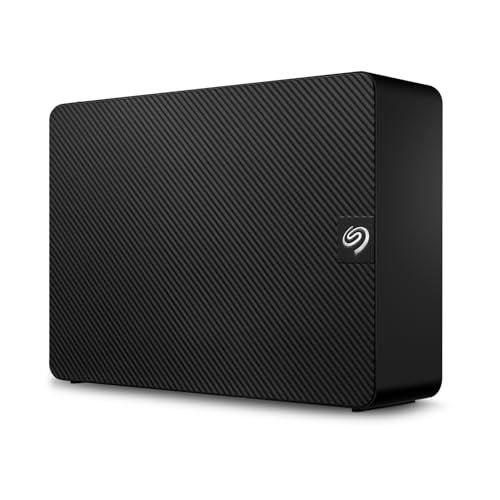
Seagate Expansion Desktop 8TB External Hard Drive
Desktop drives need mains power but cost far less per terabyte than portable units, and a backup target does not need to move often.
Best for: The local second copy sitting next to the NAS.
Check price
WD Elements Desktop 20TB External Hard Drive
One drive that can hold an entire mid-sized array. The risk is concentration: 20 TB of backup on a single unprotected spindle.
Best for: Large arrays. Buy two and rotate them rather than trusting one.
Check pricePrices change often, confirm on Amazon. As an Amazon Associate we earn from qualifying purchases.
How much backup capacity do you actually need?
Size the target against the data you hold, not the capacity of the array. This is where most of the money is saved. A four-bay NAS with four 8 TB drives has 24 TB usable and the household filling it might be holding 6 TB. Buying 24 TB of backup to match the array protects nothing extra and costs several hundred dollars more.
The formula has four terms: used space today, growth to your horizon, version history overhead, and free headroom so the target never runs full. Three years is the right horizon, because drive prices per terabyte improve enough that buying further ahead is usually worse value than buying again later. The 3-2-1 backup sizing calculator applies all four and returns a capacity you can actually buy.
Which external drive is cheapest per terabyte?
A backup target sits idle almost all the time and writes in the background at whatever rate the connection allows. It has no performance requirement anyone should pay for, which makes cost per terabyte close to the only number that matters.
| Drive | Form factor | Capacity | Price | Cost per TB | Two, for rotation |
|---|---|---|---|---|---|
| Seagate Expansion Desktop 16TB External Hard Drive | Desktop, mains powered | 16 TB | $481.50 | $30.09 | $963 |
| WD Elements Desktop 18TB External Hard Drive | Desktop, mains powered | 18 TB | $614.99 | $34.17 | $1,230 |
| Seagate Expansion Desktop 8TB External Hard Drive | Desktop, mains powered | 8 TB | $274.23 | $34.28 | $548 |
| WD Elements Desktop 20TB External Hard Drive | Desktop, mains powered | 20 TB | $700.35 | $35.02 | $1,401 |
| WD My Passport 5TB Portable Hard Drive | Portable, bus powered | 5 TB | $225.50 | $45.10 | $451 |
| WD Elements Desktop 8TB External Hard Drive | Desktop, mains powered | 8 TB | $379.99 | $47.50 | $760 |
| WD My Book Duo 16TB Desktop RAID Drive | Desktop, two drive RAID | 16 TB | $824.05 | $51.50 | $1,648 |
| SanDisk Professional G-DRIVE 12TB Desktop HDD | Desktop, mains powered | 12 TB | $669.99 | $55.83 | $1,340 |
Capacities are decimal TB as sold. Your operating system reports each about 9.05 percent smaller because it counts in binary tebibytes, so an 18 TB drive shows as 16.37 TiB, which is explained in full on the TB against TiB chart. Prices change often, confirm on Amazon.
Two patterns hold across price movements. Large desktop drives beat small ones per terabyte, because one enclosure and one power supply are amortised over more capacity: the spread here runs from $30.09 on the Seagate Expansion Desktop 16TB External Hard Drive to $55.83 on the SanDisk Professional G-DRIVE 12TB Desktop HDD. And portable bus-powered drives cost markedly more, which is a fair price for the offsite copy specifically, because a drive that fits in a coat pocket is a drive that actually leaves the house.
Is a bare drive in a dock cheaper?
Usually not, which surprises people who expect to save by skipping the enclosure. Manufacturers sell finished external drives at consumer volumes and the bare NAS drives inside them are priced for a different market, so the external is frequently the cheaper route to the same terabytes.
| Bare drive | Capacity | Price | Cost per TB | With a dock added |
|---|---|---|---|---|
| Seagate IronWolf 8TB NAS HDD (ST8000VN004) | 8 TB | $289.99 | $36.25 | $334 |
| WD Red Plus 12TB NAS HDD (WD120EFGX) | 12 TB | $459.99 | $38.33 | $504 |
| Seagate IronWolf Pro 12TB NAS HDD (ST12000NT001) | 12 TB | $438.00 | $36.50 | $482 |
| Seagate IronWolf Pro 16TB NAS HDD (ST16000NT001) | 16 TB | $579.99 | $36.25 | $624 |
| Seagate Exos 20TB Enterprise HDD (ST20000NM002H) | 20 TB | $799.99 | $40.00 | $844 |
Dock price is the SABRENT USB 3.0 Dual Bay Hard Drive Docking Station at $44.49, which is a one-time cost shared across every bare drive you own.
A dock still earns its place in three cases. If you already own spare drives pulled from an upgraded array, it turns them into backup targets for the price of the dock. If you want to rotate several bare drives like cartridges, one dock serves all of them. And it is the same tool you would already want for burn-in testing new drives before they go into the array, which makes it cheap to justify twice.
Why buy two drives instead of one bigger one?
An external drive is a single unprotected spindle with no redundancy of any kind. A 20 TB backup on one drive is 20 TB of backup that a single mechanical failure removes, and the failure that matters is the one that happens while you are restoring.
The mitigation is not a more expensive drive, it is the third copy the rule already asked for. Two identical drives, one connected and updating and one at another location, swapped on a schedule you will genuinely keep. Three details separate a rotation that works from one that quietly stops:
- Encrypt the drive that leaves the house. A backup drive is your entire household in a bag, and full-disk encryption costs nothing.
- Do not leave the target permanently mounted and writable. A share reachable from an infected client gets encrypted alongside everything else, which is the exact failure a detached copy exists to prevent. See NAS security hardening.
- Label both drives and record each swap. Two unmarked black boxes is how people overwrite the only good copy.
How long does a restore actually take?
Restore time is the argument for keeping the fast copy local, and it is the number nobody checks until they need it.
| Restore route | Sustained rate | 2 TB | 10 TB | 20 TB | 20 TB in days |
|---|---|---|---|---|---|
| USB 3.0 external drive, local | 170 MB/s | 3.3 h | 16.3 h | 32.7 h | 1.4 days |
| Bare drive in a USB dock, local | 180 MB/s | 3.1 h | 15.4 h | 30.9 h | 1.3 days |
| Second NAS over 2.5GbE | 280 MB/s | 2.0 h | 9.9 h | 19.8 h | 0.8 days |
| Second NAS over gigabit | 113 MB/s | 4.9 h | 24.6 h | 49.2 h | 2.0 days |
| Cloud, 200 Mbps download | 25 MB/s | 22.2 h | 111.1 h | 222.2 h | 9.3 days |
| Cloud, 40 Mbps download | 5 MB/s | 111.1 h | 555.6 h | 1111.1 h | 46.3 days |
Times assume a continuous transfer of large files with nothing else competing. Real restores of many small files run considerably slower, which is covered on the network throughput calculator.
That table is the whole case for a local copy two. Cloud storage is an excellent copy three: off site by definition, immune to a house fire and needing no discipline from you. It is a poor copy one, because restoring 20 TB over a typical home connection is measured in days or weeks. Keep the fast copy on a drive you can carry to the machine, and the slow copy as the one you hope never to need. The trade is worked through on NAS against cloud storage.
Should the backup drive be a second NAS instead?
For most households, no. A second NAS costs several times what two external drives cost, draws power continuously, and shares a room, a circuit and a network segment with the first one, which means it shares several of the failure modes the backup exists to survive.
Where a second unit does make sense is a remote location. A NAS at a relative's house synchronising over the internet gives you an offsite copy that updates itself, with no drive to carry and no rotation to forget. That is a genuinely better third copy than a drive in a drawer, and it is worth the money once the data set is large enough that cloud fees would exceed the hardware within a couple of years.
Who should not buy the expert pick?
The WD Elements Desktop 20TB at $700.35 holds an entire mid-sized array on one unit, which is exactly its appeal and exactly its risk. Concentration is the problem: 20 TB of backup on a single unprotected spindle.
If your data set is under about 8 TB, two 8 TB externals cost less than one 20 TB drive and give you copy two and copy three rather than a single large copy two. That is a strictly better outcome for less money, and it is the recommendation for most people reading this page.
Buy the largest single drive when the data genuinely will not fit on anything smaller, and then buy the second one before you consider the job finished. And test the restore once a quarter, because an untested backup is a hypothesis rather than a copy.
Related reading
- The 3-2-1 backup rule guide for the method behind all of this
- Backup sizing calculator to work out the capacity you need
- Drive shucking explained for what is inside these enclosures
- NAS security hardening because ransomware is the threat copy three answers
- Cost per terabyte chart for the wider pricing picture
Frequently asked questions
What size external drive do I need to back up a NAS?
Size it against the data you actually hold, not the capacity of the array. A four-bay NAS with 24 TB usable might hold 6 TB of real files, so an 8 TB external covers it today and an 18 TB drive covers several years of growth plus version history. Buying a target to match the array is the most common way people overspend on backup, often by several hundred dollars.
Is one external drive enough for a NAS backup?
One covers copy two. The rule asks for a third copy off site, and the practical way to do that with drives is to buy two identical units and rotate them, so one is connected and updating while the other lives somewhere else. That doubles the spend and is still far cheaper than a second NAS, and unlike a permanently attached drive it survives a ransomware run.
Should I leave the backup drive plugged into the NAS?
Not permanently, because a share that is always mounted and writable is reachable by anything that infects a client machine. The safer pattern is a scheduled job that mounts the target, writes, then unmounts, or a rotation where the drive spends most of its life disconnected. Snapshots on the NAS cover the fast recovery case, and the detached copy covers the case snapshots cannot.
Are external drives reliable enough for backups?
They hold the same mechanical drives found in desktops, so treat them as a single unprotected spindle with no redundancy. The mitigation is not a better drive, it is a second copy, which is exactly what the rule already asks for. Two ordinary external drives rotated on a schedule is more robust than one expensive drive, because the failure that matters is the one that hits while you need it.
Is a bare drive in a dock cheaper than an external?
Not usually, and this surprises people. External drives are often cheaper per terabyte than the bare drive inside them, because the manufacturer sells the finished product at consumer volumes. A dock earns its place when you already own spare drives, when you want to rotate multiple bare drives like cartridges, or when you also need it for burn-in testing new array drives.
Can I use an external drive as a second NAS volume instead?
You can attach one, and it is a poor primary array. USB enclosures can drop off the bus under sustained load, some bridge chips hide the drive identity so SMART monitoring stops working, and a controller reset during a write is exactly the event a parity array handles badly. External storage belongs in the backup role, where an interruption costs you a retry rather than an array.
How we choose: we compare published manufacturer specifications, drive datasheets, published reliability statistics and verified owner reviews. We do not test hardware in person, and we are not tied to any NAS vendor. Capacity and power figures here are researched guidance, not a warranty. RAID protects against drive failure, not against deletion, ransomware, fire or theft, so keep verified backups regardless of what any calculator tells you.
Working out your own cost per usable terabyte? The Home Server Build Planner is the paid version of these pages: 8 printable worksheets you fill in with your own numbers, plus the full PDF, $29.