Best Budget NAS: Cheap Boxes Worth Owning in 2026
The TerraMaster F2-425 ($239.98) is the best budget NAS: two bays for a mirror and an x86 quad-core that can run containers and hardware transcoding, which ARM boxes at the same price cannot. Spend anything you save on drives, because two 8 TB CMR drives add roughly $580 to $710 on top of the enclosure and are what actually determines the system's capacity.
Budget NAS shopping goes wrong in a predictable way: buyers compare enclosure prices, pick the cheapest one, and then discover the box was never the expensive part. Money saved on the enclosure should go straight into drives, because the drives decide capacity, rebuild time and how long the array lives. And a one-bay unit has no redundancy at all, which makes it a backup target rather than storage.
Three picks below covering roughly $139 to $390, then the honest argument about where a constrained budget should actually go. The short version: buy two bays, buy x86, and put every remaining dollar into capacity.
Best budget NAS by what you need it to do

Synology DS124 (1-Bay Diskless)
One bay means no redundancy at all, which is fine if this is a backup target rather than your only copy. You get the full DSM software stack for the price of a drive dock.
Best for: A destination for laptop backups, not a place to keep the only copy of anything.
Check price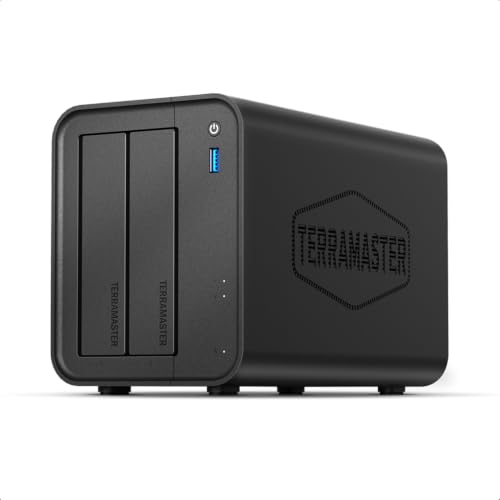
TerraMaster F2-425 (2-Bay, Quad-Core x86)
An x86 quad-core at this price is unusual, and x86 is what lets you run containers and transcode rather than just serve files.
Best for: Buyers who want mirrored redundancy and room to run a few services.
Check price
UGREEN NASync DXP2800 (2-Bay Diskless)
UGREEN pairs an Intel N100 with M.2 slots, so it handles Plex transcoding and container workloads that a low-cost ARM box cannot.
Best for: People who want budget hardware but expect to run more than a file share on it.
Check pricePrices change often, confirm on Amazon. As an Amazon Associate we earn from qualifying purchases.
Where a limited budget should actually go
Take a fixed $900 and split it two ways. Spend $390 on the enclosure and $510 is left, which buys two 4 TB drives at roughly $220 to $248 each, giving 4 TB usable in a mirror. Spend $240 on the enclosure and $660 is left, which buys two 8 TB drives at $289.99, giving 8 TB usable with change to spare.
Same money, twice the storage. That is the entire budget argument, and it holds at every price point because enclosures improve gradually while drives improve in steps you can count.
| Split of a $900 budget | Enclosure | Drives | Usable in a mirror | Total |
|---|---|---|---|---|
| Expensive box, small drives | $389.74 | 2 x $247.98 | 4 TB | $885.70 |
| Value box, mid drives | $239.98 | 2 x $289.99 | 8 TB | $819.96 |
| Cheap box, larger drives | $138.99 | 2 x $353.99 | 8 TB | $846.97 |
| Value box, larger drives | $239.98 | 2 x $353.99 | 8 TB | $947.96 |
Usable capacity is decimal TB before filesystem overhead. A two-drive mirror gives you one drive of capacity regardless of layout name. Note that the third row has no redundancy at all, because the cheap box has only one bay.
A one-bay NAS is a backup target, not storage
This needs saying plainly because the price is tempting. A single-bay NAS has no redundancy. There is no parity, no mirror and nothing to rebuild from. When the drive fails, and drives fail at roughly 1.0 to 1.6 percent per year across large fleets, everything on it is gone.
That is not a reason to avoid one. It is a reason to be honest about the job. A one-bay unit is an excellent destination for laptop backups, a place for a nightly copy of the data that already lives somewhere else. In 3-2-1 terms it is copy two, and copy two is allowed to be unprotected because copies one and three exist.
Do not make a one-bay NAS the only home for anything. If the only copy of your photos is on a single unprotected spindle, you have bought a countdown, not a backup. Size the job properly with the 3-2-1 backup sizing calculator.
Two bays and x86 are the two upgrades worth paying for
Two bays gets you a mirror, which means one drive can die without taking the data with it. It halves your usable capacity, and that is the correct trade at this budget level because the alternative is no protection at all.
x86 is the other one. An ARM NAS board is cheaper, quieter and idles around 8 W, and it will serve files well. What it will not do is run the broad Docker ecosystem comfortably or hardware transcode video, because hardware transcoding on Intel chips comes from the Quick Sync engine in the integrated graphics. An N100 or a quad-core x86 at the same price keeps those doors open for 15 to 20 W instead.
Everything else in the budget tier is negotiable. Memory can usually be upgraded, M.2 cache slots are a nice-to-have that most home workloads never benefit from, and 2.5GbE is pleasant but only matters if you also own a 2.5GbE switch. Bays and processor architecture are the two you cannot fix later.
Which two-bay build is cheapest per usable terabyte?
The budget argument above is easy to state and easy to doubt, so here it is priced out completely. Each row is the same two-bay value enclosure at $239.98 with a different pair of drives, and the column that settles the argument is the last one.
| Drive pair | Per drive | Two drives | Usable in a mirror | Complete system | Cost per usable TB |
|---|---|---|---|---|---|
| Seagate IronWolf Pro 12TB NAS HDD (ST12000NT001) | $438.00 | $876.00 | 12 TB | $1,115.98 | $93.00 |
| WD Red Plus 12TB NAS HDD (WD120EFGX) | $459.99 | $919.98 | 12 TB | $1,159.96 | $96.66 |
| Seagate IronWolf 8TB NAS HDD (ST8000VN004) | $289.99 | $579.98 | 8 TB | $819.96 | $102.50 |
| WD Red Plus 8TB NAS HDD (WD80EFPX) | $353.99 | $707.98 | 8 TB | $947.96 | $118.50 |
| Seagate IronWolf 4TB NAS HDD (ST4000VN008) | $219.00 | $438.00 | 4 TB | $677.98 | $169.50 |
| WD Red Plus 6TB NAS HDD (WD60EFZX) | $399.00 | $798.00 | 6 TB | $1,037.98 | $173.00 |
A two-drive mirror gives you one drive of usable capacity whatever the layout is called, so usable equals the single drive size. Figures are decimal TB as printed on the label, and your NAS will report each about 9.05 percent smaller because it counts in binary tebibytes. Prices change often, confirm on Amazon.
The spread runs from $93.00 per usable terabyte on the Seagate IronWolf Pro 12TB NAS HDD (ST12000NT001) build to $173.00 on the WD Red Plus 6TB NAS HDD (WD60EFZX) build, which is a difference of roughly 86 percent for the same enclosure and the same protection. The enclosure never appears in that comparison, and that is the point. Once the box is chosen sensibly, every remaining decision that matters is a drive decision, which is why how to choose NAS drives is the page to read next.
What does a budget NAS cost to run?
A NAS is a device that runs 8,760 hours a year, so idle draw is a bill you pay continuously. A two-bay x86 box with both drives spun up sits around 18 watts, which is about 158 kilowatt hours or $28 a year at 18 cents per kilowatt hour. That is small enough to ignore, and it is exactly why the free-old-desktop route is usually a false economy: a repurposed tower idling at 60 watts costs closer to $95 a year for the same job.
Two running costs are larger than the electricity and both get forgotten at this budget level. The first is the backup target, because a mirror is copy one and nothing else, and the backup sizing calculator will tell you what capacity you need for copies two and three. The second is the eventual drive replacement: mechanical drives fail at roughly 1.0 to 1.6 percent per year across large fleets and the rate rises past five years of service, so budget for a replacement pair inside the life of the box. Work your own odds on the drive failure probability calculator.
What you give up at this price, stated honestly
- ECC memory. Nothing in the budget tier has it. For a media library that is fine, for a decade-long photo archive it is a genuine gap.
- Bay count. Two bays means the only capacity upgrade available is replacing both drives, and mirrors do not grow.
- SHR. Mixed drive sizes are only used fully on Synology hardware. Everywhere else, adding a larger drive strands the excess. See SHR against RAID 5.
- Software maturity. The cheaper operating systems work, but the polish and the app catalogue are not the same, and neither is the update history.
Who should not buy the Expert pick
The UGREEN NASync DXP2800 at $389.74 is the strongest hardware here: an Intel N100 with M.2 slots, which handles Plex transcoding and container workloads a cheaper board cannot. Most budget buyers still should not buy it.
It costs $149.76 more than the two-bay value pick, and $149.76 is most of an 8 TB NAS drive. If the choice is a better enclosure with 4 TB drives or a good-enough enclosure with 8 TB drives, the second system holds twice as much for about the same total and will still be adequate in three years when the first one is full. The M.2 slots are the specific trap: read cache on a home NAS improves benchmark numbers far more than it improves anything you actually do.
Buy the Expert pick if you already know you want to run several containers plus Plex on the same box and you have the drive budget separately funded. If the $900 has to cover everything, put that money into drives instead.
Related reading
- Best NAS hard drives for where the saved budget should go, ranked by price per terabyte
- Best NAS under $500 for complete build totals including drives
- First home server buying order so you buy the right things in the right sequence
- NAS against a DIY server if you have old hardware sitting unused
- Power draw calculator because a cheap box running continuously is not cheap if it draws 70 W
Deciding on a specific model? We review the A-Tech 32GB ECC UDIMM DDR4 kit review in full.
Frequently asked questions
Is a one-bay NAS worth buying?
It is worth buying as a backup destination and nothing else. One drive has no redundancy of any kind, so when that drive fails everything on it is gone. That is perfectly acceptable if the data also lives on a laptop and in a cloud service, because the box is then copy two of three. It is not acceptable as the only home for photos or documents.
What is the cheapest NAS that is actually worth owning?
A two-bay x86 unit around $240 is the cheapest configuration that does the job properly, because two bays gives you a mirror and x86 gives you containers and hardware transcoding. Below that price you are buying either a single bay with no redundancy or an ARM processor that will only ever serve files. Both are real products, but both are narrower tools than they look.
Should I spend more on the NAS or on the drives?
On the drives, almost always. The enclosure is bought once and the drives are bought repeatedly, and the drives are what determine capacity, rebuild time and how long the array survives. A $240 box with two 8 TB drives is a better system than a $500 box with two 4 TB drives, and it costs less in total while holding twice as much.
Can I use an old PC as a NAS instead?
You can, and TrueNAS or Unraid on old desktop hardware is a legitimate route. The trade is power and noise. A desktop board with a discrete graphics card can idle at 60 to 80 W against 15 to 20 W for an N100 NAS, and at continuous operation that difference costs real money every year. Free hardware is not free once it runs for three years.
Do budget NAS units support RAID?
Any unit with two or more bays supports mirroring, and most support the standard levels their bay count allows. What varies is the extras: SHR for mixed drive sizes is a Synology feature, and ZFS with its checksumming and snapshots is generally found on TrueNAS-flavoured systems rather than on entry-level appliances. Check for the specific scheme you want rather than assuming RAID means the same thing everywhere.
How much should I budget in total for a first NAS?
Around $900 buys a sensible complete system: roughly $240 for a two-bay x86 enclosure and $650 to $710 for two 8 TB CMR NAS drives. You can cut that to about $600 with two 4 TB drives, though 4 TB is the worst value in the field per terabyte. Below $500 in total you are buying a single-bay backup target rather than primary storage.
How we choose: we compare published manufacturer specifications, drive datasheets, published reliability statistics and verified owner reviews. We do not test hardware in person, and we are not tied to any NAS vendor. Capacity and power figures here are researched guidance, not a warranty. RAID protects against drive failure, not against deletion, ransomware, fire or theft, so keep verified backups regardless of what any calculator tells you.
Working out your own cost per usable terabyte? The Home Server Build Planner is the paid version of these pages: 8 printable worksheets you fill in with your own numbers, plus the full PDF, $29.