Best NAS Under $500: Real Build Totals With Drives
The Synology DS225+ ($364.99) is the best NAS under $500, but the number that matters is the total: at $500 on the box the drives are still unbought. A realistic complete two-bay build with 8 TB CMR drives costs $820 to $950, and a four-bay build with the same drives costs around $1,900. Budget the enclosure at roughly a quarter to a third of the system.
Frame this purchase around the total, not the box. Every NAS on this page is sold diskless, so $500 spent on the enclosure means the drives are still unbought and the system holds nothing. Two 8 TB CMR drives add $580 to $710. Four add $1,160 to $1,416. That is the real shape of the spend, and the enclosure is the smaller half of it.
Three picks below under $150, under $250 and under $400, then the complete build totals at three realistic budgets so you can see what each one actually gets you once the drives are in the bays.
Best NAS under $500 by price tier

Synology DS124 (1-Bay Diskless)
Full DSM on one bay. Treat it as a backup destination, because a single drive has no redundancy of any kind.
Best for: A cheap second copy of data that already lives somewhere else.
Check price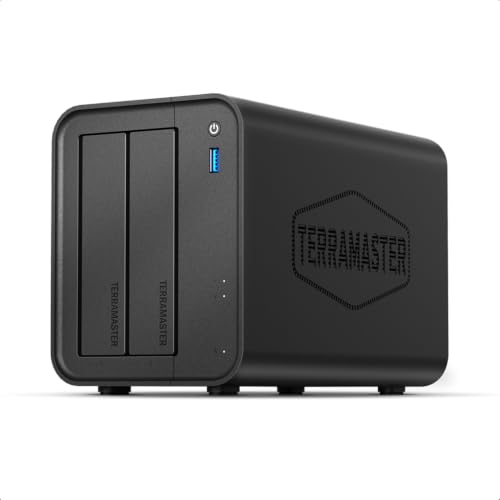
TerraMaster F2-425 (2-Bay, Quad-Core x86)
Two bays and an x86 quad-core leaves budget for the drives, which is where the money should go.
Best for: A mirrored first NAS with change left for two decent drives.
Check price
Synology DS225+ (2-Bay Diskless)
You are paying for DSM and for SHR, which is the only consumer scheme that uses mixed drive sizes properly when you upgrade later.
Best for: Buyers who value the software and expect to swap drives up over several years.
Check pricePrices change often, confirm on Amazon. As an Amazon Associate we earn from qualifying purchases.
What a complete build actually costs
These are total system costs at three budgets, using the verified drive prices from our NAS drive comparison. Usable capacity is decimal TB, which your NAS will report about 9.05 percent smaller because it counts in binary tebibytes.
| Budget | Enclosure | Box | Drives | Drive cost | Total | Usable | Cost per usable TB | Box share | Survives |
|---|---|---|---|---|---|---|---|---|---|
| $500 | Synology DS124 (1-Bay Diskless) | $138.99 | 1 x Seagate IronWolf 8TB NAS HDD (ST8000VN004) | $289.99 | $428.98 | 8 TB | $53.62 | 32% | nothing |
| $500 | TerraMaster F2-425 (2-Bay, Quad-Core x86) | $239.98 | 2 x Seagate IronWolf 4TB NAS HDD (ST4000VN008) | $438.00 | $677.98 | 4 TB | $169.50 | 35% | 1 drive |
| $800 | TerraMaster F2-425 (2-Bay, Quad-Core x86) | $239.98 | 2 x Seagate IronWolf 8TB NAS HDD (ST8000VN004) | $579.98 | $819.96 | 8 TB | $102.50 | 29% | 1 drive |
| $800 | Synology DS225+ (2-Bay Diskless) | $364.99 | 2 x Seagate IronWolf 4TB NAS HDD (ST4000VN008) | $438.00 | $802.99 | 4 TB | $200.75 | 45% | 1 drive |
| $1200 | Synology DS225+ (2-Bay Diskless) | $364.99 | 2 x WD Red Plus 12TB NAS HDD (WD120EFGX) | $919.98 | $1,284.97 | 12 TB | $107.08 | 28% | 1 drive |
| $1200 | TerraMaster F2-425 (2-Bay, Quad-Core x86) | $239.98 | 2 x Seagate IronWolf Pro 16TB NAS HDD (ST16000NT001) | $1,159.98 | $1,399.96 | 16 TB | $87.50 | 17% | 1 drive |
Totals are computed from the verified listing prices, so they cannot drift out of agreement with the cards above. Usable capacity is decimal TB before filesystem overhead, and your NAS reports it about 9.05 percent smaller because it counts in binary tebibytes, which is explained on the TB against TiB chart. Box share is the enclosure as a percentage of what you actually spend.
Two patterns fall out of that table. First, the $500 row that has redundancy holds only 4 TB, and 4 TB drives are the worst value per terabyte in the entire field. Second, every time you move money from the enclosure column to the drive column, usable capacity goes up and nothing important goes down. The $800 pair of rows is the clearest example: the same budget buys either 8 TB or 4 TB of protected storage depending purely on where you spent it.
The $500 ceiling, honestly assessed
If $500 is the hard total, you have two configurations and both involve a real compromise.
One bay with a big drive. A Synology DS124 (1-Bay Diskless) at $138.99 plus one IronWolf 8TB at $289.99 is $428.98 for 8 TB of storage with no redundancy of any kind. When that drive fails, everything on it is gone. This configuration is correct only as a backup destination for data that also lives elsewhere.
Two bays with small drives. A TerraMaster F2-425 (2-Bay, Quad-Core x86) at $239.98 plus two IronWolf 4TB drives is $677.98, which is already over the ceiling, and it gives 4 TB usable. Protected, but small, and the upgrade path is replacing both drives.
The honest recommendation is to wait. Saving to roughly $850 buys a mirrored 8 TB system that will still be adequate in three years. A $430 single-drive box is a purchase you will be re-making, not a system you are building on.
What the enclosure budget actually buys
Between $139 and $400 the differences are real but narrow. Bay count is the important one, because it is the only specification you can never change later. Processor architecture is second: an x86 chip runs Docker containers properly and can hardware transcode video through Intel Quick Sync, and an ARM chip generally cannot.
Above that you are paying for software. DSM is the most mature NAS operating system available at this price, and SHR is genuinely worth something over a multi-year ownership period even though it does nothing on day one. With two identical drives SHR is exactly RAID 1. Its value appears when you upgrade: standard RAID and ZFS truncate every member to the smallest drive and strand the excess permanently, while SHR can use the extra space as soon as a second drive matches it. Details in our SHR against RAID 5 comparison.
What does a NAS at this price cost to run?
A two-bay x86 NAS with two spinning drives draws roughly 27 to 38 W at idle: 15 to 20 W for the board and 6 to 9 W per drive. At continuous operation that is 237 to 333 kilowatt hours per year, or about $43 to $60 at 18 cents. Substitute your own tariff on the power draw calculator, which does the arithmetic including the spin-up surge that actually sizes a UPS.
That figure is small, and it is the reason the free-old-desktop route so often loses. A repurposed tower idling at 60 W costs about $95 a year for the same work, so the difference against a purpose-built two-bay box pays for a large part of the enclosure inside three years, before counting the noise and the space.
Two costs that budgets at this level almost always omit are larger than the electricity.
- A UPS. A NAS losing power mid-write is how filesystems get damaged, and the cheapest unit that lets the box see the outage and shut itself down cleanly does the whole job. An APC BE650G1 Back-UPS 650VA / 390W is $109.99 on top of the totals above. Size it on the UPS runtime calculator.
- A backup target. A mirror is copy one and nothing else. Parity and mirroring protect against a drive dying, and do nothing about deletion, ransomware, theft or fire. Work out the capacity you need on the 3-2-1 backup sizing calculator, then see backup drive picks. A Seagate Expansion Desktop 8TB External Hard Drive at $274.23 covers a two-bay mirror.
Adding both to the $819.96 two-bay build takes it to roughly $1,204.18 for a system that is genuinely finished rather than one that merely boots. That is the honest number to plan around, and it is the reason the buying order on first home server buying order puts these items where it does.
Who should not buy the Expert pick?
The Synology DS225+ (2-Bay Diskless) at $364.99 is the best enclosure on this page and it is the wrong choice for a genuinely $500 total budget. It consumes 73 percent of a $500 budget and leaves about $135 for drives, which does not buy one NAS drive worth putting in an array, let alone two.
The comparison that matters is the $800 pair of rows in the table. The DS225+ with two 4 TB drives is $802.99 for 4 TB usable. A $239.98 box with two 8 TB drives is $819.96 for 8 TB usable. You pay $17 more and get double the storage. The DSM software and the SHR upgrade path are real advantages, and they are not worth half your capacity.
Buy the DS225+ when your total budget is comfortably past $850, so the box is a third of the spend rather than three quarters. Under that, put the money into drives instead.
Related reading
- Best NAS hard drives ranked by price per terabyte, which is where this budget really goes
- Best budget NAS for the enclosure comparison on its own
- First home server buying order for what to buy first when you cannot buy everything
- RAID capacity calculator to check usable capacity before you commit to a drive set
- Best UPS for NAS for the accessory these budgets always forget
Frequently asked questions
What is the best NAS under $500?
The Synology DS225+ at $364.99 is the strongest box you can buy under $500, because DSM is the most approachable NAS operating system and SHR is the only consumer scheme that makes rolling drive upgrades work. The catch is that it leaves only about $135 of a $500 budget for drives, which is not enough for a pair. Treat $500 as the enclosure budget, not the system budget.
Does $500 include the hard drives?
Almost never, and this is the most common budgeting mistake in home storage. Nearly every NAS in this price range is sold diskless, so the listed price buys an empty chassis. Two 8 TB CMR NAS drives add roughly $580 to $710. Plan on the enclosure being about a quarter to a third of what you actually spend before the system holds a single file.
How much does a complete NAS build actually cost?
A realistic complete two-bay build with 8 TB drives lands around $820 to $950 including the enclosure. Four bays with 8 TB drives lands closer to $1,900. If the hard ceiling is $500 in total, the honest configuration is a one-bay unit at $138.99 plus one 8 TB drive at $289.99, which comes to $428.98 and gives you a backup target with no redundancy.
Is a two-bay NAS enough?
It is enough to start and it is limited by design. A mirror gives you one drive of usable capacity and survives one failure, which is genuine protection. What it does not give you is growth: the only way to add capacity to a two-bay mirror is replacing both drives. If you expect the library to double, four bays now costs less than four bays later.
Should I buy a cheaper NAS and better drives, or the reverse?
Cheaper NAS, better drives, with one exception. The enclosure is bought once and the drives are bought repeatedly, so drive capacity compounds in value while enclosure features mostly do not. The exception is bay count and processor architecture, because neither can be changed later. Buy the cheapest box that has enough bays and an x86 chip, then spend everything else on capacity.
What does SHR add on a two-bay NAS?
Nothing at all today, and quite a lot later. With two identical drives SHR produces exactly the same mirror as RAID 1. Its value appears when you replace one drive with a larger one, because SHR can use the additional space once a second drive matches it, whereas standard RAID truncates every member to the smallest drive and strands the rest permanently.
How we choose: we compare published manufacturer specifications, drive datasheets, published reliability statistics and verified owner reviews. We do not test hardware in person, and we are not tied to any NAS vendor. Capacity and power figures here are researched guidance, not a warranty. RAID protects against drive failure, not against deletion, ransomware, fire or theft, so keep verified backups regardless of what any calculator tells you.
Working out your own cost per usable terabyte? The Home Server Build Planner is the paid version of these pages: 8 printable worksheets you fill in with your own numbers, plus the full PDF, $29.