Best NAS for Plex: Quick Sync Picks and What to Avoid
The UGREEN NASync DXP4800 Plus ($656.99) is the best NAS for Plex because its Pentium Gold 8505 carries a modern Intel Quick Sync engine, which handles several simultaneous 4K HEVC transcodes. Avoid NAS units built on AMD Ryzen embedded chips such as the V1500B and R1600: they have no integrated graphics, so every transcode falls to the CPU cores.
One specification decides whether a NAS is good at Plex, and it is not the core count. Intel Quick Sync, the fixed-function video engine built into Intel integrated graphics, is what makes hardware transcoding possible at all. A chip that has it will transcode several 4K streams while barely warming up. A chip that lacks it will fall over on one. Everything else on this page follows from that.
Three picks below, then the technical reasoning: why the processor matters, why AMD Ryzen NAS units are the wrong shape for this job, and why the transcode you avoid entirely beats the transcode you accelerate.
Best NAS for Plex by household size
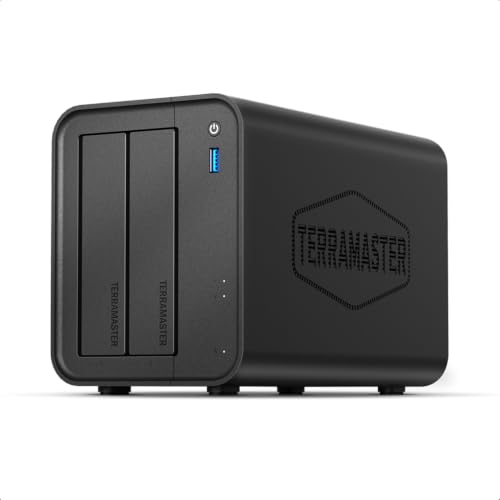
TerraMaster F2-425 (2-Bay, Quad-Core x86)
Intel quick sync on an x86 chip is what makes hardware transcoding possible at all. Two bays limits the library, but the silicon is the right kind.
Best for: One or two simultaneous streams from a library that fits in a mirrored pair.
Check price
UGREEN NASync DXP4800 Plus (4-Bay, Pentium Gold 8505)
A five-core Pentium Gold with modern Quick Sync handles several 4K HEVC transcodes at once, which is where most cheaper boxes give up.
Best for: A household with three or four people streaming different things at the same time.
Check price
Asustor Lockerstor 4 Gen3 AS6804T (4-Bay, 10GbE)
ECC memory and 10GbE matter for large ZFS-style workloads. For Plex specifically, most of that budget would be better spent on drives.
Best for: Home labs where Plex is one workload among many, not the reason for the purchase.
Check pricePrices change often, confirm on Amazon. As an Amazon Associate we earn from qualifying purchases.
Why Intel Quick Sync is the whole decision
Transcoding means decoding a video file and re-encoding it into a format or bitrate the client can handle. It is genuinely expensive work. Done in software on general purpose cores, a single 4K HEVC stream can consume an entire quad-core processor and still stutter.
Quick Sync is dedicated silicon that does the decode and encode in hardware, and it changes the cost by roughly an order of magnitude. On a modern Quick Sync generation, several simultaneous 4K HEVC transcodes run on a low-power chip that idles in the teens of watts. That is why a modest Pentium Gold beats a much larger processor without an integrated GPU at this one task.
Plex Pass required. Hardware transcoding is a paid Plex feature. Buying the right silicon and then not enabling the subscription leaves you doing everything in software anyway.
Why AMD Ryzen NAS units cannot hardware transcode
Several well-regarded NAS units are built on AMD Ryzen embedded parts, most commonly the V1500B and the R1600. Both are capable server chips with good multi-core throughput, and both are a poor fit for Plex for a specific reason: they have no integrated graphics.
No integrated GPU means no video engine, which means there is nothing for Plex to offload to. Every transcode falls to the CPU cores in software. The V1500B is a four-core, eight-thread part at modest clocks, which handles perhaps one 1080p software transcode and is not a realistic 4K transcoding platform.
This is not a criticism of those units generally. They are excellent bulk-storage and container hosts, and a Ryzen-based NAS serving direct play to wired clients will never break a sweat. It is a criticism of buying one for Plex, which is a specific job that wants specific silicon.
| Processor class | Integrated graphics | 4K HEVC hardware transcodes | 1080p software transcodes | Verdict for Plex |
|---|---|---|---|---|
| ARM NAS SoC | None usable | 0 | 0 to 1 | Direct play only |
| AMD Ryzen V1500B | None | 0 | 1 | Wrong silicon for transcoding |
| AMD Ryzen R1600 | None | 0 | 1 | Wrong silicon for transcoding |
| Intel Celeron J4125 | Quick Sync, older | 1 to 2 | 1 | Adequate for a small household |
| Intel N100 | Quick Sync, modern | 2 to 4 | 1 to 2 | Strong value |
| Intel Pentium Gold 8505 | Quick Sync, modern | 4 or more | 2 to 3 | The sweet spot |
| Intel Core i5-1235U | Quick Sync, modern | 4 or more | 3 to 4 | More than Plex alone needs |
Stream counts are the guidance published by Plex and reported consistently by owners, not figures measured here. Real capacity depends on source bitrate, target bitrate, subtitle handling and how many streams also need audio conversion.
Direct play beats every transcode you can accelerate
Direct play means the client receives the original file untouched and decodes it locally. The server reads from disk and pushes bytes down the wire, and that is all. It uses almost no processing power, and it always looks better than a transcode because there is no re-encoding step to lose quality in.
The fastest way to improve a Plex server is therefore not a faster processor. It is removing the reasons transcodes happen:
- Fix the clients. An Apple TV, a recent Nvidia Shield or a modern smart TV app direct plays almost everything. A browser tab direct plays almost nothing.
- Convert image-based subtitles. PGS and VOBSUB tracks from Blu-ray rips must be drawn onto the video frames, which forces a full transcode. SRT text subtitles are sent alongside and cost nothing.
- Watch the audio track. A client that cannot handle TrueHD or DTS-HD triggers an audio conversion, and depending on the client that can pull the video along with it.
- Keep a compatible copy. For the handful of titles that always transcode, storing a second H.264 version costs disk space, which is cheaper per hour than processing power.
Bitrate against your network link
Transcoding also happens when the link cannot carry the file. A 4K HEVC remux commonly runs 50 to 80 Mbps and a full Blu-ray remux can exceed 100 Mbps. Set against real-world throughput, 1GbE tops out around 113 MB per second, which is roughly 900 Mbps, 2.5GbE around 280 MB per second and 10GbE around 1,100 MB per second.
A wired gigabit client can therefore direct play several 4K remuxes simultaneously, and the array behind it keeps up easily, since a single 7200 rpm drive sustains roughly 150 to 260 MB per second sequential. The failure cases are Wi-Fi and remote streaming, and those are exactly when Plex decides to transcode rather than buffer. Check your own numbers with the network throughput calculator.
Who should not buy the Expert pick
The Asustor Lockerstor 4 Gen3 at $1,517.99 has ECC memory, four M.2 slots and 10GbE, and for Plex specifically it is the wrong place to put your money. It costs $861 more than the UGREEN pick. That $861 is two 12 TB NAS drives, which is 24 TB of raw capacity, or roughly 200 more 4K films.
The 10 gigabit port does not help a Plex library, because even a 100 Mbps remux uses about a ninth of a gigabit link. ECC does not help a media library much either, since the content is re-acquirable. And spending the enclosure budget here leaves less for drives, which is the thing a media server actually runs out of.
Buy it if Plex is one workload among several on a box that also runs virtual machines and large ZFS datasets. If Plex is the reason you are shopping, put that money into drives instead and buy the transcoding silicon you need rather than the network port you do not.
Related reading
- How to set up Plex for library layout, hardware transcoding settings and client configuration
- Best NAS hard drives because a media library is a drive purchase before it is a processor purchase
- 2.5GbE against 10GbE for whether the faster port is worth anything to you
- RAID capacity calculator to size the array your library will need
- Best 8-bay NAS if the library has already outgrown four bays
Frequently asked questions
Do I need Intel Quick Sync for a Plex NAS?
You need it if the server will ever transcode. Quick Sync is a fixed-function video engine inside Intel integrated graphics that decodes and re-encodes streams without loading the general-purpose cores. A modern Quick Sync block handles several simultaneous 4K HEVC transcodes on a low-power chip. Without it, one 4K software transcode can saturate a quad-core processor and stutter, so the presence of Quick Sync matters more than core count.
Can an AMD Ryzen NAS transcode for Plex?
Only in software. The AMD Ryzen embedded parts used in NAS units, the V1500B and the R1600, have no integrated graphics at all, so there is no hardware video engine for Plex to call. Every transcode falls to the CPU cores. Those chips are perfectly capable file servers and they run containers well, but for a Plex library that needs transcoding they are the wrong silicon.
What is direct play and why does it matter?
Direct play means the client receives the original file untouched and decodes it itself, so the server does nothing but read from disk and push bytes down the wire. It costs almost no processing power and always looks better than a transcode, because no re-encoding step is involved. Fixing your clients and your file formats so they direct play is worth more than any processor upgrade you can buy.
Why do subtitles make Plex transcode?
Image-based subtitle formats such as PGS and VOBSUB found in Blu-ray rips cannot be passed to a client as text. Plex has to draw them onto the video frames, which means decoding and re-encoding the entire stream even when the client could have played the original file untouched. Text-based subtitles like SRT are sent alongside the video and cost nothing. Converting your subtitle tracks to SRT removes a large share of transcodes.
How much bandwidth does a 4K Plex stream need?
A 4K HEVC remux commonly runs 50 to 80 Mbps, and a full Blu-ray remux can exceed 100 Mbps. Gigabit ethernet carries around 113 MB per second, or roughly 900 Mbps, so a wired client handles several of those at once. Wi-Fi and remote streaming are where it breaks down, and that is precisely when Plex decides to transcode rather than fail.
How many bays does a Plex NAS need?
Media libraries grow faster than any other home storage workload, so size for the library you will have rather than the one you have now. Four bays under single parity with 12 TB drives gives 36 TB usable, which holds a large 4K collection. Two bays is workable if the library is mostly 1080p, but expect to replace both drives inside a couple of years.
How we choose: we compare published manufacturer specifications, drive datasheets, published reliability statistics and verified owner reviews. We do not test hardware in person, and we are not tied to any NAS vendor. Capacity and power figures here are researched guidance, not a warranty. RAID protects against drive failure, not against deletion, ransomware, fire or theft, so keep verified backups regardless of what any calculator tells you.
Working out your own cost per usable terabyte? The Home Server Build Planner is the paid version of these pages: 8 printable worksheets you fill in with your own numbers, plus the full PDF, $29.