How to Set Up Plex on a NAS: Transcoding and Storage
Plex performance on a NAS comes down to one thing: whether the processor has Intel Quick Sync. Celeron J4125, N100, Pentium Gold 8505, Core i3-N305 and Core i5-1235U do. Atom C3538, AMD Ryzen embedded V1500B and V1780B, Realtek and Arm parts do not, and on those every transcode runs in software with roughly one 1080p stream as the ceiling. Hardware transcoding also requires an active Plex Pass. A 4K HDR library of 1,400 hours needs about 45 TB, against about 4 TB for the same content in 1080p.
Everything about running Plex on a NAS reduces to one question: does the processor have Intel Quick Sync, and do you have a Plex Pass to use it? Get both right and a 650 dollar four-bay box comfortably serves several simultaneous 4K streams. Get either wrong and a 1,400 dollar eight-bay unit stutters on a single one, because every transcode falls to general purpose cores that were never designed for video.
The second question is storage, and the answer varies by a factor of ten depending on what you collect. The same 1,400 hour library is about 4.23 TB in 1080p streaming encodes and about 36.9 TB as untouched Blu-ray remuxes. Decide which you are before you order drives, because drives are where the money goes.
Plex NAS picks by library size and stream count
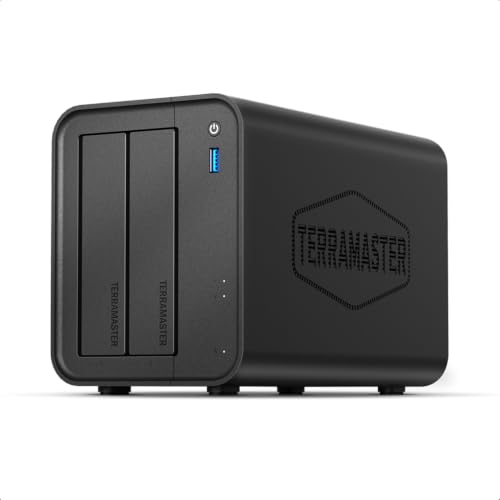
TerraMaster F2-425 (2-Bay, Quad-Core x86)
Intel quick sync on an x86 chip is what makes hardware transcoding possible at all. Two bays limits the library, but the silicon is the right kind.
Best for: One or two simultaneous streams from a library that fits in a mirrored pair.
Check price
UGREEN NASync DXP4800 Plus (4-Bay, Pentium Gold 8505)
A five-core Pentium Gold with modern Quick Sync handles several 4K HEVC transcodes at once, which is where most cheaper boxes give up.
Best for: A household with three or four people streaming different things at the same time.
Check price
Asustor Lockerstor 4 Gen3 AS6804T (4-Bay, 10GbE)
ECC memory and 10GbE matter for large ZFS-style workloads. For Plex specifically, most of that budget would be better spent on drives.
Best for: Home labs where Plex is one workload among many, not the reason for the purchase.
Check pricePrices change often, confirm on Amazon. As an Amazon Associate we earn from qualifying purchases.
What is direct play, and why is it always the goal?
Direct play means the client receives the file byte for byte as it is stored and does all the decoding itself, so the server does nothing but read from disk and push bytes down the wire. A NAS drawing 30 W can direct play a dozen streams at once, because it is doing file serving, which is what it was built for.
There are three modes and the difference between them is enormous:
- Direct play. Container, video codec, audio codec and subtitles are all things the client understands. The server reads and sends. Processor usage is close to nothing.
- Direct stream. The video is passed through untouched, but the container is repackaged or the audio track is converted, usually because the client cannot handle a multi-channel format. Cheap, a few percent of a core.
- Transcode. The server decodes the video and re-encodes it, typically to a lower resolution or bitrate. This is expensive, and whether it is feasible at all depends entirely on the silicon.
Transcoding gets triggered by a short list of causes: the client cannot decode the codec, the connection is too slow for the source bitrate, a burned-in subtitle track needs to be rendered into the picture, or the user has manually selected a lower quality. Three of those four are avoidable, which is why the last section of this page is about eliminating transcodes rather than surviving them.
Which processors can hardware transcode for Plex?
Intel Quick Sync is a fixed-function video engine built into Intel integrated graphics that encodes and decodes video in dedicated silicon rather than on the processor cores. It is the single feature that separates a NAS which handles several 4K streams from one that cannot manage a single one, and it is either present or absent with no middle ground.
The absence is the part people get caught by, because several expensive NAS units do not have it. AMD Ryzen embedded parts used in higher-end boxes and Atom server chips have no integrated GPU that Plex can use at all. Realtek and Arm parts in budget units have media engines their vendors use for their own applications, which Plex cannot address. In all of those cases the fallback is software transcoding on the cores, and the practical limit is about one 1080p stream.
| Processor | Video engine | 1080p transcodes | 4K SDR to 1080p | 4K HDR, tone mapped |
|---|---|---|---|---|
| Intel Celeron J4125 | Quick Sync, Gen 9 | 6 to 8 | 2 | 1, poorly |
| Intel N100 / N95 | Quick Sync, Xe | 8 to 10 | 3 | 2 |
| Intel Pentium Gold 8505 | Quick Sync, Xe | 10 or more | 4 | 2 to 3 |
| Intel Core i3-N305 | Quick Sync, Xe | 12 or more | 4 to 5 | 3 |
| Intel Core i5-1235U | Quick Sync, Xe | 15 or more | 6 | 4 |
| Intel Atom C3538 | None | 1, in software | 0 | 0 |
| AMD Ryzen V1500B | None | 1 to 2, in software | 0 | 0 |
| AMD Ryzen V1780B | None | 1 to 2, in software | 0 | 0 |
| Realtek RTD1619B | None usable by Plex | 0 | 0 | 0 |
| Annapurna Labs AL-324, Arm | None usable by Plex | 0 | 0 | 0 |
Stream counts are what each class of engine is generally reported to sustain with Plex Pass hardware acceleration enabled, drawn from published specifications and widely reported owner configurations rather than from testing of our own. Treat them as a ranking rather than a guarantee: real numbers move with source bitrate, subtitle handling and how much else the NAS is doing.
Among the boxes worth buying, the UGREEN NASync DXP4800 Plus pairs a Pentium Gold 8505 with four bays, which is the mainstream answer. The Asustor Lockerstor 4 Gen3 runs a Core i3-N305 and adds 10GbE, which matters if you also move large files around rather than only streaming them. At the budget end the TerraMaster F2-425 uses a quad-core Intel x86 part, and that word Intel is the qualifying detail rather than the core count. Full comparisons are in best NAS for Plex.
Check the exact processor before you buy, not the price. Several eight-bay units costing well over a thousand dollars run AMD Ryzen embedded parts with no integrated GPU, so they are worse at Plex than a 240 dollar Intel two-bay. Spending more does not buy Quick Sync. Reading the specification sheet does.
Do you need Plex Pass for hardware transcoding?
Yes, and it is worth stating plainly because it catches people who did everything else right. Hardware accelerated encoding and decoding is a Plex Pass feature. Without an active subscription or a lifetime pass, the server ignores Quick Sync entirely and transcodes in software, which on a low-power NAS chip means one stream if you are lucky.
So the Plex budget has two lines, not one: the box with the right silicon, and the pass that unlocks it. Once it is active, enable hardware acceleration explicitly in the transcoder settings, because it is not on by default, and then confirm it is working by starting a transcode and checking that the dashboard labels the session with a hardware indicator rather than plain "Transcode". A configuration that looks right and is not actually using the engine is a common and quiet failure.
If a subscription is not something you want, the alternative is a library built entirely for direct play: one codec, one container, no burned-in subtitles, clients that all handle it. That is a real strategy and it works, and the last section covers how.
Why does HDR tone mapping cost so much more?
Tone mapping is the conversion of a high dynamic range picture into standard dynamic range, which is required whenever an HDR source is transcoded for a client that cannot display HDR. It is not a simple resize. Every frame has its colour volume remapped, and that work is pixel-by-pixel maths on top of the decode and encode already happening.
The result is that a 4K HDR transcode costs roughly twice what the same 4K SDR transcode costs on the same engine, which is why the last two columns of the table above diverge. A box managing four simultaneous 4K SDR conversions manages two or three HDR ones. Older Quick Sync generations handle it especially badly, and on a Celeron J4125 the result is often watchable in name only.
Worse, an HDR film tone mapped badly looks washed out and grey even when it plays smoothly, so the quality complaint and the performance complaint arrive together. The fix is not a faster NAS, it is a client that plays HDR natively, at which point the file direct plays and the entire problem disappears. Keeping an SDR copy of the handful of films most watched on non-HDR devices is cheaper than buying processor headroom to convert them repeatedly.
Where should the transcode directory live?
The transcode directory is scratch space where Plex writes the segments it is generating while a stream plays, and it is written to continuously for the whole duration of every transcode. By default it sits on the array, which is the worst place for it.
Two problems follow from leaving it there. The drives never get to idle, because something is always writing, and the write stream competes with every other read the array is serving. On a parity array each of those small writes also means a parity update, which multiplies the work.
Three sensible placements, in ascending order of speed:
- A SATA SSD in a spare bay or an M.2 slot. A Samsung 870 EVO 2TB or the smaller 1TB version is far more space than needed, and the surplus makes a good home for application data and container volumes too. The WD Red SA500 is the NAS-rated M.2 option where the box has a slot.
- An NVMe drive in an M.2 slot, if the NAS has one. Faster than needed for this job, but the slot is often otherwise unused.
- A RAM disk, which is free and faster than either. Point the transcode directory at a temporary filesystem in memory. Budget a few gigabytes per concurrent stream and make sure the box has memory to spare after everything else, because running out is not graceful. Adding a 16GB SODIMM is often cheaper than adding an SSD.
Whichever you choose, remember that transcode scratch is disposable by definition. It never needs parity, it never needs backing up, and a single consumer SSD with no redundancy is entirely appropriate. Do not spend on redundancy for data whose lifetime is one playback session.
How much storage does a Plex library actually need?
Library size is hours of content times bitrate, and bitrate varies by a factor of a hundred between a music file and a Dolby Vision remux. Bitrate in megabits per second times 0.45 gives gigabytes per hour, which is the only conversion you need.
| Content | Typical bitrate | Per hour | 100 hours | 500 hours | 2,000 hours |
|---|---|---|---|---|---|
| Music library, FLAC lossless | 1 Mbps | 0.45 GB | 45 GB | 225 GB | 900 GB |
| TV episode, 1080p H.264 | 5 Mbps | 2.25 GB | 225 GB | 1.13 TB | 4.5 TB |
| Film, 1080p H.264 streaming encode | 8 Mbps | 3.6 GB | 360 GB | 1.8 TB | 7.2 TB |
| Film, 1080p H.265 streaming encode | 5 Mbps | 2.25 GB | 225 GB | 1.13 TB | 4.5 TB |
| Film, 4K SDR H.265 encode | 25 Mbps | 11.25 GB | 1.13 TB | 5.63 TB | 22.5 TB |
| Film, 1080p Blu-ray remux | 30 Mbps | 13.5 GB | 1.35 TB | 6.75 TB | 27 TB |
| Film, 4K HDR H.265 encode | 45 Mbps | 20.25 GB | 2.02 TB | 10.13 TB | 40.5 TB |
| Film, 4K HDR Blu-ray remux | 80 Mbps | 36 GB | 3.6 TB | 18 TB | 72 TB |
| Film, 4K Dolby Vision remux | 100 Mbps | 45 GB | 4.5 TB | 22.5 TB | 90 TB |
Bitrates are typical published figures for each format. Sizes are decimal TB as drive makers count them, so your NAS will report each figure about 9.05 percent smaller in binary tebibytes. A two hour film is two of the per-hour figures, so a 4K HDR remux film is roughly 72 GB.
Put a concrete library through it. 800 hours of film, which is roughly 400 titles, plus 600 hours of television, which is about 60 seasons:
- All 1080p streaming encodes: about 4.23 TB. A two-bay NAS with a pair of 8 TB drives handles this with room to grow.
- All 4K HDR encodes: about 22.95 TB. Four bays with 16 TB drives, or a smaller array you plan to upgrade.
- All Blu-ray remuxes: about 36.9 TB. Four bays with 24 TB drives, or eight bays. This is where the storage bill overtakes the box by several times.
| Four-bay plan | Raw | Usable, single parity | As the NAS reports it | Hours of 1080p | Hours of 4K HDR |
|---|---|---|---|---|---|
| 8 TB drives | 32 TB | 24 TB | 21.8 TiB | 6,667 h | 1,185 h |
| 12 TB drives | 48 TB | 36 TB | 32.7 TiB | 10,000 h | 1,778 h |
| 16 TB drives | 64 TB | 48 TB | 43.7 TiB | 13,333 h | 2,370 h |
| 20 TB drives | 80 TB | 60 TB | 54.6 TiB | 16,667 h | 2,963 h |
| 24 TB drives | 96 TB | 72 TB | 65.5 TiB | 20,000 h | 3,556 h |
Single parity on four identical drives gives three drives of usable capacity, since every layout truncates each member to the smallest drive. The fourth column is the same figure in binary tebibytes, which is what the interface will show. Work through mixed drive sizes, SHR, RAIDZ and every standard level on the RAID capacity calculator.
Which RAID level is right for a media library?
Single parity is a defensible choice for media in a way it is not for anything else, because a media library is usually re-acquirable and a document archive is not. RAID 5, RAIDZ1 and SHR all give you three drives of usable capacity out of four, and if the worst happens you lose time rather than irreplaceable data.
That reasoning has limits, and they are worth being honest about. It stops applying when the library contains anything you cannot get again: home video, ripped discs you no longer own, or anything you spent years assembling. It also weakens as drives get larger, because a rebuild has to read every sector of every surviving member, and at 20 TB members that is a long window during which the array has no protection. The full argument is in RAID 5 against RAID 6.
A practical split that most people land on: single parity for the media volume, double parity or a proper backup for the photos, documents and home video. Two volumes on one NAS is entirely normal, and it puts the expensive protection only where it is earned. Whatever you choose, parity is not a backup, and a media array with no second copy is one accidental deletion away from a re-ripping project. The 3-2-1 backup rule guide covers what a real second copy looks like, and it is more affordable for media than people expect because a single large external drive holds a lot of film.
How do you avoid transcoding entirely?
The cheapest transcode is the one that never starts, and most transcoding in home setups is caused by the client rather than by the server. Fixing the client side is free and it makes a modest NAS behave like an expensive one.
- Use a client that decodes what you store. A dedicated streaming box or a modern television handles H.265, HDR and multi-channel audio natively. A browser tab handles almost none of it, which is why the web player transcodes constantly. Swapping the client is a much better investment than upgrading the processor.
- Turn off automatic quality adjustment on local clients. Plex clients default to adapting quality to the connection, and on a fast local network that adaptation is pure loss. Set local playback to original quality and the transcodes stop.
- Keep subtitles external rather than embedded in an image format. Text subtitle files are overlaid by the client for free. Image-based subtitle tracks must be rendered into the picture, which forces a full video transcode of an otherwise perfectly compatible file.
- Store one codec, consistently. A library that is entirely H.264 direct plays almost everywhere. A library that is a mixture of everything will always find a client that cannot handle some of it.
- Check the network before blaming the processor. A 4K remux at 80 Mbps needs a link that can carry it. Over Wi-Fi at a distance it cannot, so Plex transcodes down to fit, and the symptom looks like a slow server. NAS networking basics covers what each link speed actually delivers.
- Keep a second copy of the handful of files that always transcode. If two or three films are watched constantly on an old device, storing a 1080p SDR version alongside the 4K one costs a few gigabytes and removes the load permanently. Storage is cheap; a 12 TB NAS drive costs a fraction of the processor upgrade that would achieve the same result.
One last piece of housekeeping worth doing on day one: put the Plex metadata and database on the SSD as well as the transcode directory. The library database is thousands of small random reads and writes, and it is the reason a large library feels sluggish to browse on an otherwise fast NAS. A drive bracket and a spare bay solve it permanently.
Related reading
- Best NAS for Plex for the boxes with Quick Sync, compared
- How to choose NAS drives for the half of the budget that holds the library
- RAID capacity calculator for usable space across every layout
- Best SSD for a NAS for the transcode and metadata drive
- 3-2-1 backup rule guide because a media array is still not a backup
Frequently asked questions
What is the difference between direct play and transcoding in Plex?
Direct play means the client receives the file exactly as stored and decodes it itself, so the server does almost no work. Direct stream means the video is untouched but the container or the audio track is repackaged. Transcoding means the server decodes the video and re-encodes it into something the client can handle, which is by far the most expensive of the three. Direct play is always the goal.
Which NAS processors can hardware transcode for Plex?
Intel chips with Quick Sync, and effectively nothing else. Celeron J4125, N100, Pentium Gold 8505, Core i3-N305 and Core i5-1235U all qualify. Atom C3538, the AMD Ryzen embedded V1500B and V1780B, Realtek media chips and Arm parts do not have an integrated GPU Plex can use, so every transcode falls to the processor cores and one 1080p stream is often the limit.
Do I need Plex Pass for hardware transcoding?
Yes. Hardware accelerated encoding and decoding is a Plex Pass feature, and without an active subscription or lifetime pass the server transcodes entirely in software regardless of what silicon is present. Buying a NAS specifically for Quick Sync and then not buying Plex Pass leaves the whole capability switched off, so budget for both together or plan a library that never needs to transcode.
How many 4K streams can a NAS handle?
With Quick Sync on a modern Intel part, roughly 4 to 6 simultaneous 4K SDR transcodes down to 1080p, or 2 to 4 if the source is HDR and needs tone mapping. Without an integrated GPU the answer is zero: a Ryzen embedded or Atom NAS cannot transcode 4K in software at watchable speed. If four people watch 4K at once, plan for direct play instead of counting on transcodes.
How much storage does a Plex library need?
A library of 800 hours of film and 600 hours of television is about 4.23 TB in 1080p streaming encodes, about 22.95 TB in 4K HDR, and about 36.9 TB as untouched Blu-ray remuxes. Format choice moves the requirement by a factor of ten, so decide whether you are collecting remuxes before you buy drives rather than after.
Where should the Plex transcode directory go?
On an SSD, or in RAM if the box has memory to spare. Transcoding writes segment files continuously while a stream plays, and putting that on the spinning array means the drives never idle and every stream competes with file access. A small SATA or NVMe SSD removes the contention entirely. A RAM disk is faster still and costs nothing, but it needs headroom of a few gigabytes per concurrent stream.
How we choose: we compare published manufacturer specifications, drive datasheets, published reliability statistics and verified owner reviews. We do not test hardware in person, and we are not tied to any NAS vendor. Capacity and power figures here are researched guidance, not a warranty. RAID protects against drive failure, not against deletion, ransomware, fire or theft, so keep verified backups regardless of what any calculator tells you.
Working out your own cost per usable terabyte? The Home Server Build Planner is the paid version of these pages: 8 printable worksheets you fill in with your own numbers, plus the full PDF, $29.